What is characteristic impedance?
The characteristic impedance of a transmission line, also known as characteristic impedance, refers to the impedance per unit length when the transmission line is propagating electromagnetic signals.
Characteristic impedance is usually used to describe the characteristics of the transmission line. It is the sum of the resistance and reflection encountered by electromagnetic waves when propagating in the transmission line.
In high-speed signal transmission applications such as DDR, PCIE differential, or SATA, the signal transmission line can no longer be regarded as an ideal wire. Parasitic parameters such as parasitic resistance, parasitic capacitance, and parasitic inductance need to be considered.
The transmission line per unit length can be equivalent to the following model:
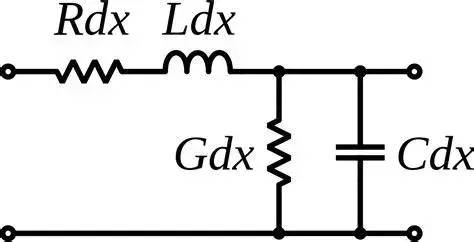
The impedance expression of this model is:
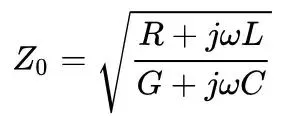
Theoretically, the precise characteristic impedance is a frequency-related quantity. However, in practical applications, the resistance part of the transmission line, that is, the part that dissipates energy, can often be ignored. That is, R and G in the above formula are 0. It is approximated as a lossless transmission line.
For a lossless transmission line, the impedance expression can be expressed as:
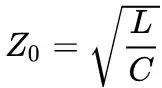
Where L is the inherent inductance per unit length of the transmission line, and C is the inherent capacitance per unit length of the transmission line. Through this simple calculation formula, it can be seen that to change the characteristic impedance of the transmission line, the inherent inductance and capacitance per unit length of the transmission line must be changed.
PCB traces are often said to control 50Ω, and coaxial line impedance is 50Ω or 75Ω. Under imprecise requirements, impedance is not related to frequency.
Factors affecting the characteristic impedance of transmission lines:
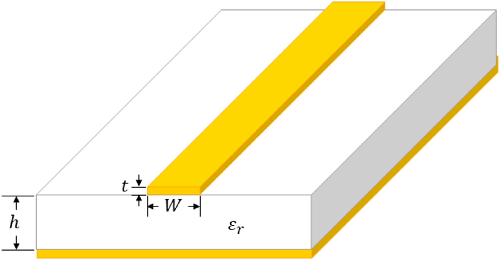
Factors affecting characteristic impedance (taking microstrip lines as an example)
Trace width: Trace width is inversely proportional to characteristic impedance. Increasing trace width is equivalent to increasing capacitance, which reduces characteristic impedance.
Dielectric constant: Dielectric constant is inversely proportional to characteristic impedance. Increasing dielectric constant is equivalent to increasing capacitance.
Distance between transmission line and reference plane: Increasing the distance between transmission line and reference plane is equivalent to reducing capacitance, which reduces characteristic impedance.
Conductor thickness: Conductor thickness is inversely proportional to characteristic impedance. Due to the skin effect, the impact is smaller than other factors.
How to do impedance matching?
Impedance matching is a concept in microwave electronics. For transmission lines, that is, all high-frequency signals can be transmitted to the load point, and no signal will be reflected back.
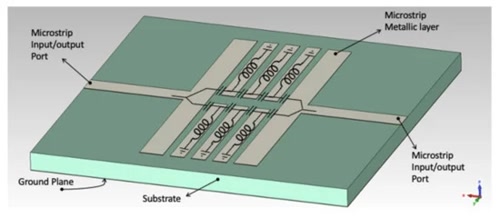
Microstrip line PCB transmission line model
There are generally two ways to achieve impedance matching: changing the characteristic impedance (lumped-circuit matching) and adjusting the wavelength of the transmission line (transmission line matching).
When doing impedance matching, we need to use the Smith chart:
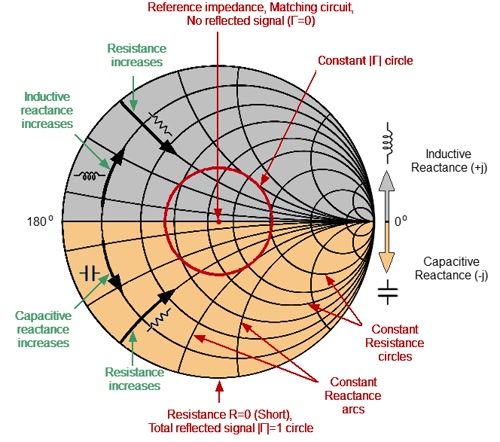
The horizontal line of the Smith chart: purely represents the real part of the impedance, that is, the resistance.
Circle: represents the impedance circle.
Upper half circle: represents the real part and positive imaginary part (inductance region).
Lower half circle: represents the real part and negative imaginary part (capacitance region).
Change the characteristic impedance
By connecting a capacitor or inductor in series with the load, the impedance value of the load can be increased or decreased, and the corresponding impedance point will move along the impedance circle. Adjust the capacitance and inductance accordingly to adjust the characteristic impedance of the transmission line, so that the input impedance and output impedance match.
Adjust the wavelength of the transmission line
Adjusting the wavelength of the transmission line can be achieved by changing the length of the transmission line. For example, by increasing the length of the transmission line, the signal can experience more phase changes during transmission, thereby achieving impedance matching at a specific length. In practical applications, methods such as stub matching or quarter-wavelength impedance transformers can be used for impedance matching.
If the impedance is matched, the transmission power is large. For a power supply, when its internal resistance is equal to the load, the output power is maximized, and the impedance is matched at this time.
Taking a broadband amplifier with an output impedance of 50Ω as an example, if maximum power transmission is required and no signal reflection occurs, impedance matching needs to be considered. If the signal wavelength is much greater than the cable length, impedance matching does not need to be considered.

 WeChat