When Wide Bandgap Semiconductors Meet "Traditional Packaging"
As electric vehicles pursue longer driving ranges and AI data centers consume increasingly higher amounts of power, industry demands for power chips have reached unprecedented heights. Wide bandgap semiconductors, represented by Silicon Carbide (SiC) and Gallium Nitride (GaN), have become the key to solving energy bottlenecks due to their high-frequency, high-efficiency, and high-voltage-resistant characteristics.
In traditional packaging, long bonding wires and complex routing generate high parasitic inductance, causing severe voltage spikes, oscillations, and additional losses during switching transients. These issues not only limit performance but may also trigger overvoltage breakdown and electromagnetic interference, becoming the core bottleneck constraining wide bandgap device performance.
Power chip embedding technology is not merely a change in packaging form, but a system-level engineering solution.
Through this fundamental structural transformation of power chip embedding, the paths for current and heat are reconstructed from the source. It systematically addresses three core challenges faced by wide bandgap semiconductors (SiC/GaN) in traditional packaging applications: high parasitic parameters, thermal dissipation difficulties, and reliability challenges.
Challenge 1: High Parasitic Parameters Limiting Performance
Wide bandgap devices (such as SiC) switch more than 10 times faster than silicon devices. The long bonding wires and complex routing in traditional packaging generate high parasitic inductance, causing severe voltage spikes, oscillations, and additional losses during switching transients. These issues not only limit chip performance but may also cause overvoltage breakdown and electromagnetic interference.
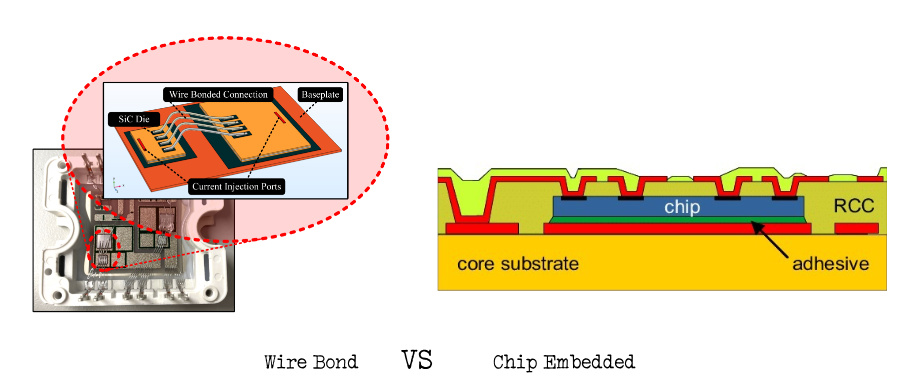
source:Technical Understanding of Resin-Coated-Copper (RCC) Lamination Processes for Realization of Reliable Chip Embedding Technologies&High-Frequency Non-Invasive Magnetic Field-Based Condition Monitoring of SiC Power MOSFET Modules
How Embedding Technology Solves This: By embedding power chips inside the PCB and replacing bonding wires with direct plated copper vias, the length and area of current loops are minimized. This significantly reduces parasitic inductance, substantially decreases voltage spikes and parasitic oscillations, and lowers switching losses.
Challenge 2: High Heat Flux Leading to High Junction Temperatures
SiC chips typically have only 1/3 to 1/5 the area of silicon chips with equivalent power ratings, resulting in heat flux densities 5-10 times higher. Traditional packaging mostly relies on single-sided heat dissipation from the chip, with long paths and high thermal resistance. Heat cannot be quickly extracted, leading to excessively high junction temperatures that directly degrade performance and lifespan.
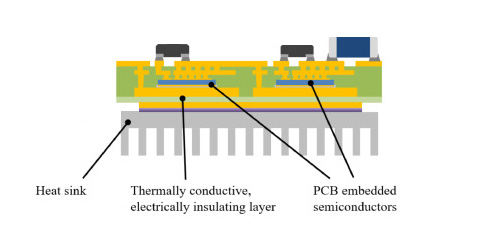
Source:Printed circuit board embedded power semiconductors: A technology review Till Huesgen
How Embedding Technology Solves This: PCB embedding technology enables "dual-sided heat dissipation" for chips. After embedding, the chip's backside can directly contact large-area copper layers, while heat from the front side is conducted upward through plated copper vias, forming an efficient 3D thermal dissipation channel. Additionally, embedded ceramic insulation solutions (such as high-thermal-conductivity Si₃N₄ AMB substrates) can be introduced, with thermal conductivity (>90W/mK) far exceeding traditional FR4 materials, providing the ultimate solution for thermal bottlenecks in high-voltage, high-power scenarios.
Challenge 3: High Operating Stress Shortening Lifespan
Frequent switching, massive thermal shock, combined with differences in thermal expansion coefficients among various materials, subject power modules to extremely high thermo-mechanical stress. In traditional packaging, bonding wires are highly susceptible to fatigue and detachment due to power cycling, and solder joint cracking is also common, becoming the primary cause of system failure.
How Embedding Technology Solves This: By embedding power chips inside the PCB and replacing fragile bonding wires with PCB via copper interconnects, the main risk of bonding wire fatigue and detachment is eliminated. Optimized material matching and stack-up design can effectively reduce thermal stress and improve cycle life.
Infineon's S-Cell Solution
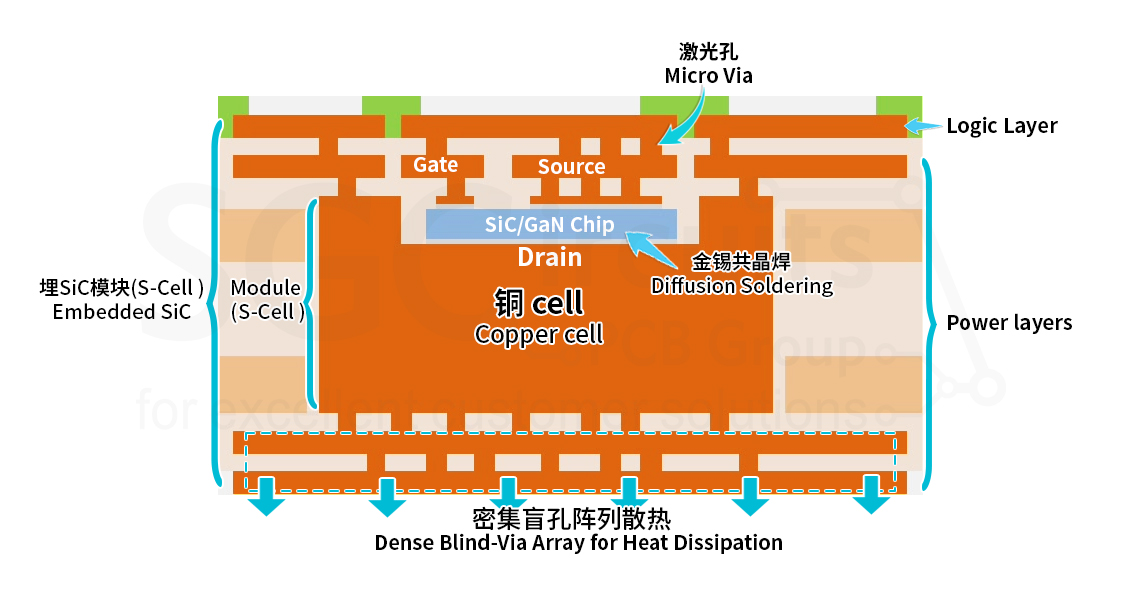
The essence of S-Cell (Standard Cell) is a pre-assembled standardized power unit. Its manufacturing process begins with a thick copper lead frame with cavities. Power chips are connected through diffusion soldering, transient liquid phase bonding (TLPB), or silver sintering processes, ultimately forming a structure where the chip surface is flush with the copper frame surface. This allows the S-Cell to be laminated and embedded into PCBs like ordinary components, reducing connection failures caused by stress concentration.
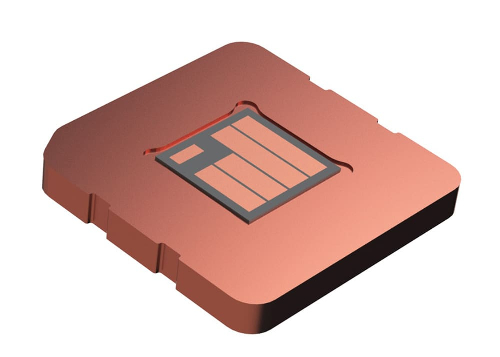
source:infineon.cn
Core Advantages of the S-Cell Solution:
Standardization: Greatly simplifies design, procurement, and assembly processes, lowering the barrier to entry for embedded power module applications.
High Performance: After embedding, the parasitic parameters of the switching half-bridge are extremely low, with thermal management and interconnect reliability reaching new heights.
High Integration: Gate drivers, bus capacitors, and other components can be tightly arranged around the S-Cell, forming a complete ultra-compact inverter "brick" with astonishing power density.
Flexible and Scalable: Multiple S-Cells can be flexibly paralleled on the PCB to cover different power levels with the same packaging architecture, perfectly aligning with platform modularization and scalability strategies.
AMB-Based Power Module PCB Embedding Solution
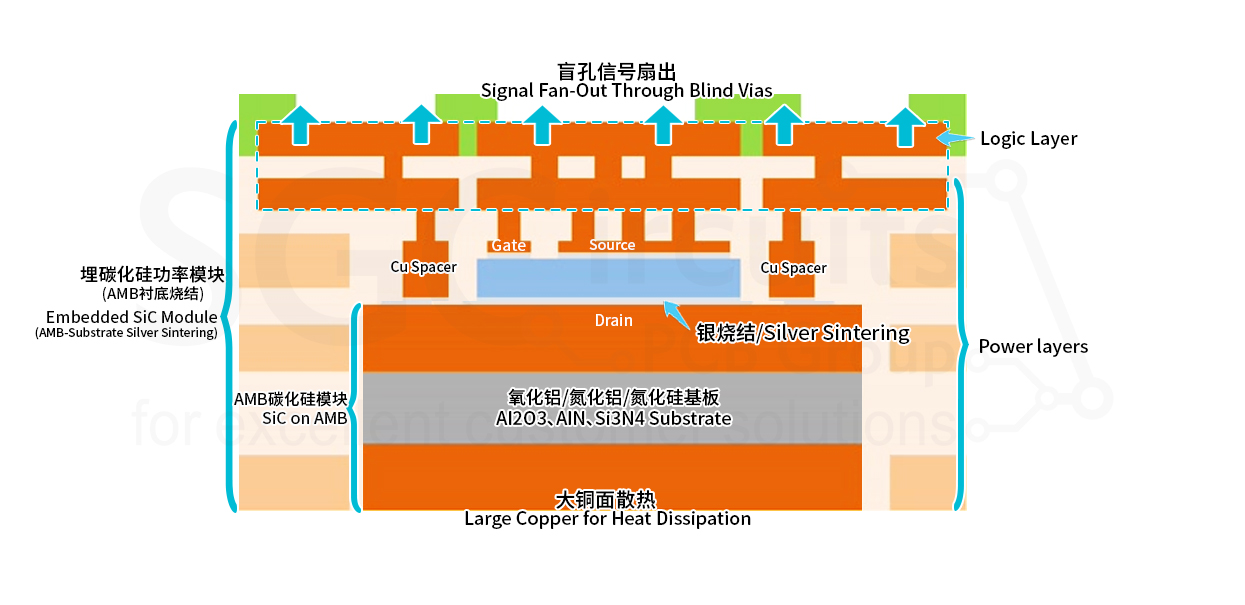
The SiC power chip's drain is directly mounted on the copper surface of the AMB substrate through silver sintering or soldering processes. The source and gate are connected to external circuits through plated copper vias, while the bottom copper layer of the AMB substrate is connected to the bottom heat dissipation surface through vias.
In power modules, the backside of the chip (usually the drain) is at high voltage potential. If directly connected to the copper plate of a heatsink, the entire heatsink would become electrically charged. Therefore, a reliable insulation layer must exist between the chip and the heatsink.
When embedding power modules in PCBs, if FR4 material is used for insulation, its thermal conductivity is only 0.3W/mK. This extremely low thermal conductivity creates a significant thermal bottleneck.
By incorporating high-thermal-conductivity AMB (Active Metal Brazing) ceramic substrates into the PCB structure for embedded power modules, thermal performance of 80-90W/mK can be achieved while providing insulation—tens to hundreds of times better than FR4. This has become the technical path to solving thermal bottlenecks in high-voltage, high-power scenarios.
Core Advantages of AMB-Insulated Power Modules:
Meets High-Voltage Design Requirements: Easily satisfies stringent insulation requirements for 800V and above high-voltage platforms.
Ultimate Thermal Path: Chip heat passes directly through the AMB ceramic to the heatsink, with extremely low thermal resistance and doubled heat dissipation efficiency.
High Power Density: Excellent thermal performance allows for more compact module designs, thereby increasing overall output power.
High Reliability: AMB materials and sintered connection interfaces demonstrate far superior reliability under high temperatures and high power cycling compared to traditional organic materials.
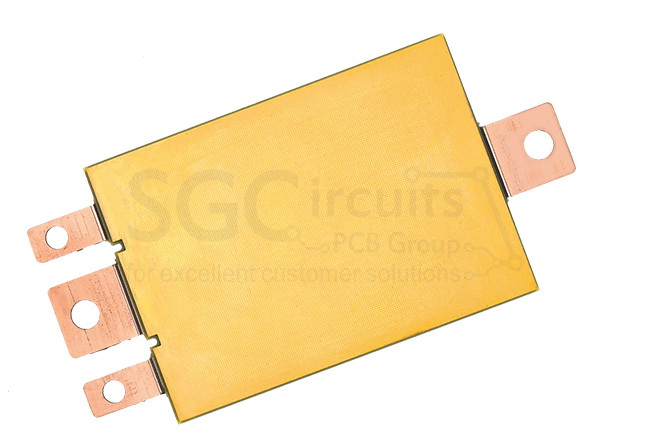
The image below shows an SiC embedded power module based on AMB insulation produced by Sunshine. We not only master the core embedding process but can also provide PCB solutions tailored to specific customer requirements.
From electric vehicle drive systems to AI data center power supply units, PCB power chip embedding technology is becoming the core cornerstone of next-generation power electronics, leveraging its comprehensive advantages in electrical, thermal, and reliability performance.
Sunshine is committed to helping customers fully unleash the potential of wide bandgap devices through leading PCB embedding technology, jointly building a more efficient, reliable, and compact power world.

 WeChat